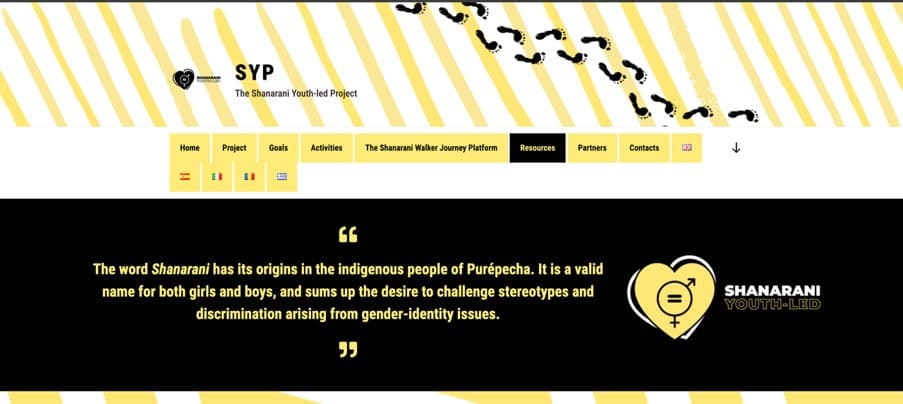
Shanarani Youth-led Project: Challenging Gender Stereotypes Together
Gender stereotypes shape our lives from an early age as we are born into a society that comes with expectations, beliefs and structures that will impact and affect our lives. Working with young people from UK, Greece, Italy, Romania and Spain, the Shanarani Youth-led Project aimed to challenge the current paradigm.
Countries covered: | Greece, Italy, Romania, Spain, United Kingdom |
|---|---|
Period: | 2020-22 |
Funding: | €198,758 |
Type: | Strategic Partnerships for youth |
Background
The Shanarani Youth-led Project grew from the learning of an earlier Shanarani project in 2017. Our starting point was simple: if we want lasting change, we work WITH young people rather than FOR young people.
The project brought together partners from the UK, Greece, Italy, Romania and Spain to explore how youth-led approaches could make conversations about gender stereotypes more relevant and meaningful. A key aim was to move beyond approaches that focus on discrimination against just one gender. Instead, participants were encouraged to understand how stereotypes affect everyone, and how they can influence everyday choices, relationships, education and opportunities.
The project also recognised that young people are daily surrounded by media. Films, TV shows, music, advertising and social media can reinforce stereotypes; but they also provide a great starting point for questioning them.
Young people were encouraged and motivated to lead on their own discovery around the issues of gender stereotypes. In this way, young people were active participants in their own growth rather than mere spectators. The project empowered young people to combat gender stereotypes through innovative educational tools. We co-created a youth-worker curriculum using film and theatre, an interactive online game, a mobile app, and a comprehensive e-book.
How it worked
During the 24 month project, our partner organisations met in Modena (Italy), Vélez-Málaga (Spain) and London (UK) to collaborate, share resources and train educators.
The project was split into 4 phases.
Phase 1: Curriculum & Workshops (Sept 2020 – Aug 2022). We updated national research on gender stereotypes and co-designed a youth-led curriculum using cinema, theatre, TV, music, and advertising. Translated into 5 languages (English, Greek, Italian, Romanian, Spanish), local workshops reached 138 youth workers and 166 young people.
Phase 2: Web Platform & Game (Sept 2021 – Aug 2022). We created the interactive platform Shanarani Walker Journey, structured into 5 virtual destinations with myth-busting, media analysis, reflection tasks, and a virtual wall. This was adapted into 5 national versions and piloted with 100+ users.
Phase 3: Multiplier Events & Dissemination (May 2022 – Aug 2022). We organised workshops in Reggiolo, Modena, Granada, Torre del Mar, Craiova, Athens, and London with live platform demos for youth workers, teachers, students, parents, and policy stakeholders. Digital campaigns (social media, press, radio) reached over 19,000 indirect beneficiaries.
Phase 4: E-Book & Policy Synthesis. We consolidated research, workshop learnings, evaluations and policy recommendations into an open-access e-book featuring national chapters in 5 languages alongside an English comparative synthesis.
Young people helped shape, test and evaluate the activities through a Youth Advisory Board, making sure the resources reflected their real experiences.
The approach was also designed to give youth workers and educators a choice of ways to engage young people: by means of direct face-to-face youth-led training, an online game, or a mobile application. A key output from the project was the interactive Shanarani Walker Journey, a gamified online platform where users travelled through five virtual destinations. Along the way, they challenged myths, explored media messages and reflected on their own experiences.
A mobile app and two open-access books were developed, with resources translated into 5 languages. At multiplier events, workshops and digital campaigns across Europe, we directly trained 138 youth workers and 166 young people through interactive workshops, while more than 100 users piloted the digital learning tools. Dissemination activity reached around 20,000 people indirectly.
Results and impact
The results showed that the youth-led approach made a real difference.
For young people, the project increased awareness of gender-based discrimination and helped participants recognise stereotypes in situations they encounter every day. 94% of young participants reported gaining skills to identify gender discrimination, while 87% learned to spot more subtle gender bias in media.
Importantly, participants were developing the confidence to discuss stereotypes with peers, question what they see and hear, and think about how gender expectations affect their own lives.
Youth workers and other professionals also gained practical skills. They learned how to identify gender-based discrimination, enhancing their capacity to support at-risk youth with CPD-accredited methodologies. The response was particularly strong: 99.6% of surveyed professionals said they would use the Shanarani tools in their ongoing work.
A lasting legacy
Perhaps the biggest achievement was changing how gender stereotypes were discussed. By putting young people at the heart of the project, Shanarani created learning that felt relevant rather than imposed.
The partnership strengthened cooperation between organisations, educators and community actors across Europe, creating an international network for sharing ideas and good practice.
The resources remain available for organisations to use, giving the project a life beyond its funding period. More importantly, the experience demonstrated that when young people are trusted to lead, they can become powerful contributors to conversations about equality, human rights and social change.
Shanarani's message is straightforward: don't just design solutions for young people — create them with young people.
To find out more about this case study, visit the Erasmus+ project database.
“If you are considering applying for Erasmus+ funding, do not hesitate—take the leap. It is far more than just a grant; it is a genuinely transformative journey for both organisations and individuals.
“The competencies and confidence gained through Erasmus+ ripple outward. They elevate your internal team dynamics and project a stronger, more professional presence to external stakeholders, partners, and the community you serve.”
Barbara Grazzini, Cofounder | Chief Executive | Project Manager at InEuropa srl Italy