Wheelchair instructors for martial arts
A Finnish martial arts organisation, Voimisteluseura Keski-Uusimaa ry in Tuusula, wanted to make wheelchair martial arts available in a region where no suitable groups or instructor training existed. By working with international partners, four instructors were trained, the organisation developed practical guidance, and the foundations were laid down for accessible, certified training that can be shared across Finland and Europe.
Countries covered: | Finland, Sweden, Germany |
|---|---|
Period: | 2024-25 |
Funding: | €14,230 |
Type: | Mobility of Sport Coaches and Staff |
Background
For many people, martial arts are about much more than learning how to fight. They can build confidence, independence, physical fitness and a sense of belonging. But for people who use wheelchairs, finding an opportunity to practise martial arts can be extremely difficult.
In south-west Finland, there were no wheelchair martial arts groups available. Across Finland, opportunities were also very limited, with only a small number of individual participants training in different clubs. There was another major gap: there was no established training programme for coaches who wanted to teach wheelchair users.
The organisation applied for Erasmus+ funding to support them to change this.
Objectives
The main objective was to develop the skills and knowledge needed to start wheelchair martial arts groups locally, while creating a training model that could eventually be shared with other clubs and instructors across Finland and Europe.
A key part of the project was developing instructor training. The aim was not simply to teach coaches a few adaptations, but to create a structured and professional approach to wheelchair martial arts.
Implementation
The team made two visits to partner clubs abroad to gain practical experience and learn from organisations already working in adapted martial arts.
The first visit was to Lund, Sweden, where the team took part in the Martial Arts of All Styles (MAAS) coach training, phase one. The programme combined theory with practical teaching. Coaches explored different teaching methods, pedagogy, self-development and assessment, using real examples to understand how training could be adapted.
The second visit was to Germany, where wheelchair martial arts and self-defence were included in the training. This provided valuable information about wheelchairs, health considerations and the different ways that disabilities and medical conditions can affect physical movement.
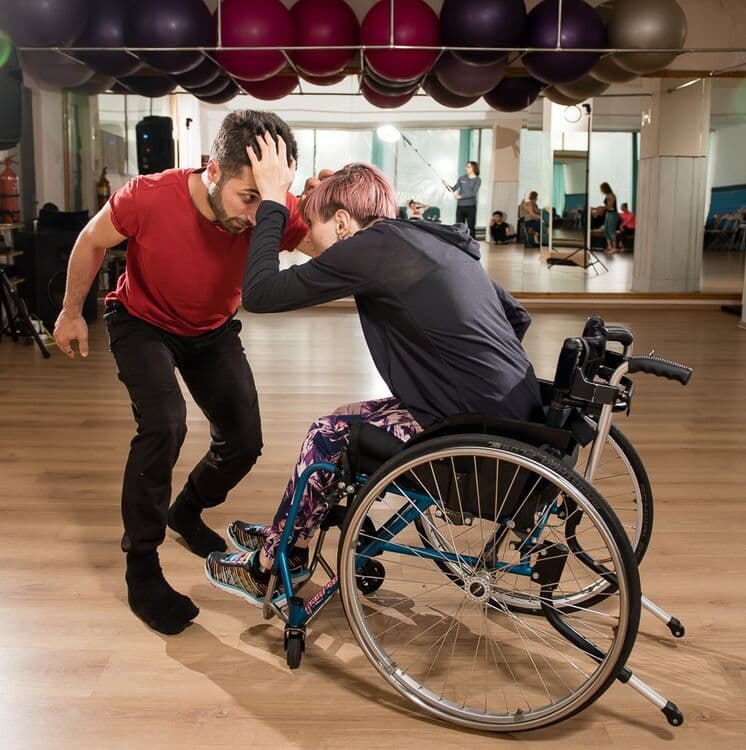
The practical experience was especially important. The team spent almost three days training and moving around in wheelchairs. This gave instructors the chance to experience martial arts from a wheelchair user's perspective, including how to move, train, fight and defend themselves.
Results and impact
The project also highlighted the importance of facilities and equipment. Club staff gained a much better understanding of the practical arrangements needed to make training genuinely accessible.
The long-term goal is to turn the knowledge gained into a certified instructor programme. Certification will help ensure that instructors receive consistent training and that students can feel confident that their coaches have met an agreed standard.
The theoretical part will also become an online course. Instructors will complete this before moving on to the practical training, making the programme easier to access regardless of location.
There is also a longer-term vision for wheelchair students themselves. As they progress through the martial arts grading system, they can eventually become assistant instructors and, later, coaches. This creates a pathway for wheelchair users to take on the same responsibilities and opportunities as other students.
The project has already delivered the outcomes it set out to achieve.
Four instructors are now able to teach wheelchair martial arts students and train additional instructors. The club has the knowledge needed to establish wheelchair martial arts groups and offer self-defence courses.
A written instructor guide has also been developed. Work is now underway to turn this into a finished book and online learning course.
Perhaps most importantly, the project has created the foundations for wheelchair martial arts to grow beyond one club or one region. The organisation plans to continue sharing its knowledge with other clubs and coaches and to support international cooperation.
The project shows what can happen when accessibility is approached practically and collaboratively. It is helping remove barriers, develop new instructors and give wheelchair users a genuine opportunity to practise martial arts, build independence and become part of the wider martial arts community.
To find out more about this case study, visit the Erasmus+ project database.