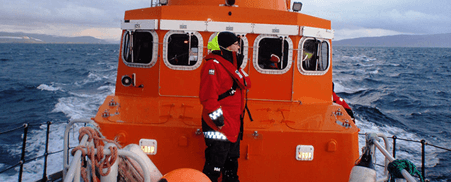
RNLI – developing skills to save lives at sea
The Royal National Lifeboat Institution saves over 400 lives a year and relies on the support of dedicated volunteers to provide its 24-hour search and rescue service. However only one in ten volunteers join the RNLI from a professional maritime occupation.
Countries covered: | Denmark, Finland, Germany, Iceland, Netherlands, Norway, Sweden, United Kingdom |
|---|---|
Period: | 2015-2017 |
Funding: | €24,660,00 |
Type: | Adult education staff mobility |
Marine emergency search and rescue services across Europe face the same challenges and through Erasmus+, RNLI volunteers were able to further develop the essential skills needed to save lives at sea. The adult education Mobility project ‘European Lifeboat Crew Exchange’ provided a unique experience for volunteers to take part in an exchange for maritime rescue services overseas for up to seven days.
Participants were able to develop their technical skills, job-shadow experts from other European countries and receive training which could be passed on to the volunteers in their own local crew when they returned to the UK.
Saving lives in the UK
Callum Robinson had been on the crew of his local lifeboat centre in Rhyl for over 10 years. He was inspired to join by his father who volunteered at the station before he was born.
Callum was one of a group of RNLI volunteers to travel to Oslo in Norway through an Erasmus+ funded Mobility project. After his Erasmus+ experience, Callum went on to work on the national flood rescue team in addition to serving the crew at Rhyl Lifeboat Station – one of the busiest stations in Wales for emergency call outs.
'I found the exchange extremely valuable. Not only did I learn new skills but how to use the equipment we already have in more effective ways. There is a lot of training involved for volunteers – from basic things like standing in the boat in extreme weather to using all the different equipment.'
Callum Robinson
During the exchange Callum learned about techniques and new equipment used by Norwegian emergency search and rescue. This included firefighting from the boat, a new training facility which incorporated a helicopter crash scenario set in water and unique equipment for cutting clothing from casualties when they are injured.
'I am able to refer back to what I learnt and say in Norway they did this and it worked well. It is vital to be able to pass on these kinds of skills and techniques.'
Implementation
Erasmus+ funding allowed the project team to:
- Prepare the exchange week together with partner organisations
- Select participants out of lifeboat crew members and prepare them for the exchange
- Cover the costs for the group to travel to and stay in Norway for training and job shadowing
- Evaluate the exchange, and implement improvements regarding training and/or organisational issues
- Feedback from the participants to local co-workers and organisations and share the results using several communication channels
- Ensure compliance of the project to Erasmus+ Agency.
Wider impact
At an organisational level, the Mobility project facilitated the professional development of volunteers, helping to develop their competencies both within emergency rescue services and their daily lives.
Project co-ordinator Oliver Mallinson explained the project was also a stepping stone in developing a validation method for recognising the skills required by volunteers both in the UK and internationally. 'The collaboration of maritime emergency search and rescue organisations across Europe allows lifesaving best practices to be shared internationally and help retain committed volunteers.'
To find out more about this case study, visit the Erasmus+ project database